Most owners I talk to have already tried something with AI. A chat tool for emails, a feature in the job software, maybe a pilot someone sold them. And when I ask what changed in the business, the answer is usually not much.
Usually the plan started with the tool. Somebody picked a product, and then everyone went looking for work it could do.
A strategy for a small or mid-sized service company works the other way round. You start with the work your team does every week, decide what AI should take over, what it should only prepare, and what stays with people. Then you decide the order. The tools come last.
Here’s how we do that with the companies we work with.
Start with one number
Before anything else, pick one number you’d be glad to see move. Days from a finished job to the invoice. Quotes that never got a second follow-up. Hours a week your office manager spends on the same few tasks.
If you can’t count it today, that’s fine. Write down that you can’t. Not knowing the number is often the first real finding.
Sort the work into three kinds
Then look at the work behind that number, step by step, with the people who do it. Not the people who manage it. They describe how it should go. The people doing it know how it actually goes.
Every step falls into one of three groups.
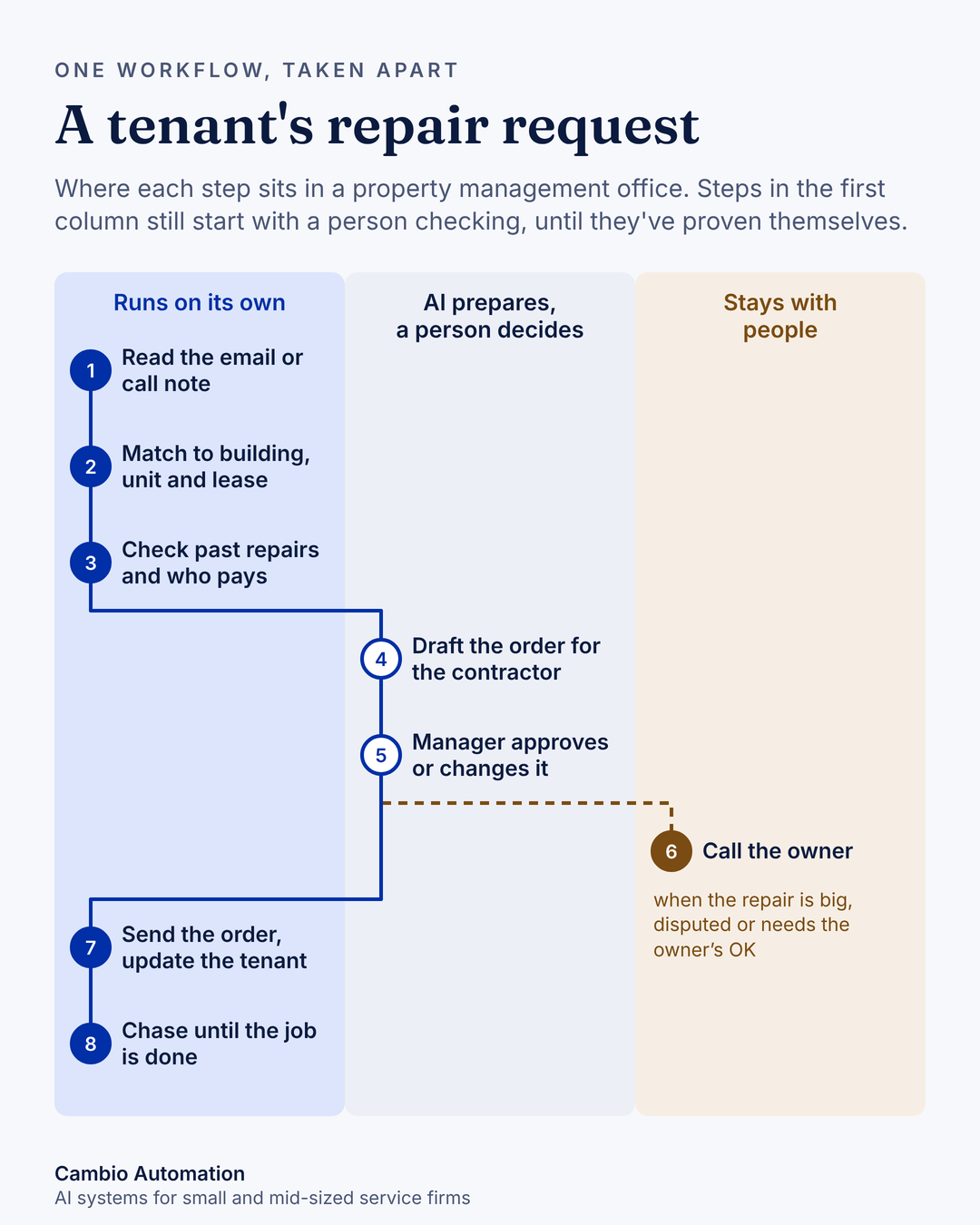
Work a rule can check. Filing a document in the right folder, matching an invoice to a job, sending the standard reminder. If you can write down exactly when it was done right, it belongs here. This is where AI can eventually run on its own.
Work that needs judgment. Answering a customer who is unhappy with a quote, deciding which job gets the free slot, writing the email where the tone matters. AI can prepare it, a person decides.
Work that rests on a relationship. The call with your biggest customer, the supplier you’ve known for fifteen years, the conversation about a price exception. That stays with people. AI can help them prepare, nothing more.
The more judgment a piece of work needs, the better AI has to be before it can run without anyone checking it. Rule work gets there first, judgment takes much longer, and relationships rarely get there at all.
Decide the order
Now you have a list of steps and you know which kind each one is. The order comes from two questions. What is it worth, in hours or in money? And how hard is it to do well, including what happens when it goes wrong?
Start with one quick win: something worth real hours, mostly rule work, where a mistake doesn’t land on a customer. Get that live on real work before you start the next one.
Two rules keep the order honest. If you can’t connect to the data a step needs, it isn’t a quick win, however good it looks on paper. And no team gets more than two changes a month. People need time to get used to each one, and a team that is changed too often stops trusting all of it.
Give every step an owner
Every workflow needs one person inside the company who owns the result. Usually that’s not you as the owner, because you’re already the person everything waits on. It’s the person who does the work today and who will check the drafts in the first weeks.
That person also decides, together with you, when a step is ready for more freedom.
Let steps earn the right to run alone
Nothing should run on its own from day one. A new step starts with a person reading every draft. After a few weeks of drafts that went out unchanged, the person only reads the ones the system marks as unsure, plus a sample. Later, only the exceptions reach a person.
A step moves up only after it has proven itself, never in your busiest month, and it can always move back. If something goes wrong, one switch puts a person back in front of it.
Write down what you’ll never automate
Every company has a few things that should never be handed to a system. Prices and discounts. Disputes. Anything that commits the company. The customers you most want to keep.
Write them down early. It saves a lot of discussion later, and it tells your team you’ve thought about what matters to them.
What a good start looks like
It doesn’t need a big project or a year of planning. When we map how a company works, it takes about six hours of the team’s time in total, spread over two weeks. The owner gets two short sessions, the people who do the work get half an hour each.
What you want at the end is simple. One workflow running on real work, one number you’re counting, one owner. Then the next workflow, chosen the same way.
One German property manager we work with has four employees. Over time, the systems we built took more than 80 hours of recurring office work a month off that team, about half a full-time job. Each of them started from a piece of work the team did every week, not from a tool.